

14 min readBy Joshua Leleux
Table of Contents
- How Sunlight and UV Radiation Damage Hardwood Floors
- Assess Existing Fading and Identify Sun Damage
- Using Window Film to Protect Floors From UV Rays
- Best Window Treatments to Prevent Floor Fading
- Apply Hardwood Floor Protective Coating and UV-Resistant Finishes
- How to Restore Sun-Damaged Hardwood Floors
- Create a Room-by-Room Protection Plan Based on Sun Exposure
- Frequently Asked Questions
Last Updated: October 20, 2026
How Sunlight and UV Radiation Damage Hardwood Floors
Sunlight damages hardwood floors through UV radiation and heat. UV rays break down the lignin and cellulose that give wood its color and strength, causing fading and uneven color.
Most homeowners don't notice until entire floor sections look bleached or yellowed compared to areas protected by furniture or rugs.
The damage happens in two ways:
- UV radiation penetrates the wood finish and breaks down pigments
- Solar heat causes the wood to expand and contract, weakening the finish over time
South-facing windows let in the most intense sunlight, east and west-facing rooms get strong morning and afternoon exposure, and even north-facing rooms fade slowly over time.
Standard floor finishes block only 10-20% of UV rays, so unprotected floors fade noticeably within 2-3 years of direct sunlight exposure.
Assess Existing Fading and Identify Sun Damage
Identifying sun damage correctly is the first step to fixing it. Stains, water damage, and normal wear look different from UV fading.
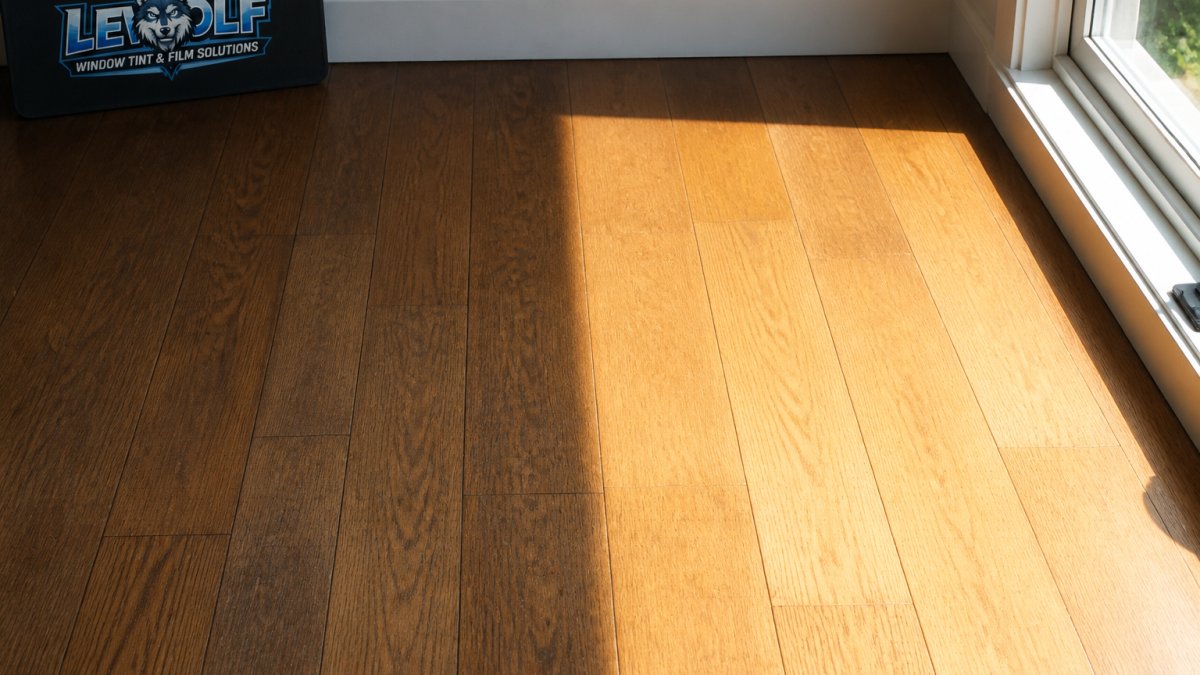
Sun damage has specific characteristics:
- Pattern follows window light. Fading is heaviest near windows and fades gradually toward the center of the room
- Shadow lines are visible. You'll see sharp lines where furniture blocked sunlight
- Color change is uniform. The faded area looks lighter or more yellow than protected wood
- Edges are soft. Unlike water stains or scratches, sun damage has no sharp boundaries
To assess your floors, move all furniture to one side of the room for a week, then move it back and compare the exposed area to the protected area.
Check the finish too: if it's chalky or dull, UV rays have damaged the coating; if it's still glossy but the wood underneath looks lighter, the damage is in the wood itself.
Using Window Film to Protect Floors From UV Rays
Window film blocks 99% of UV rays while letting visible light through, making it one of the most effective ways to protect hardwood floors from sun damage. It sits on the glass, stopping damage before it starts.
Can Window Tinting Stop Harwood Floors From Fading? | Campbell WIndow Film
Campbell Window Film
UV-blocking film absorbs ultraviolet radiation before it reaches your wood and reduces solar heat by 30-50%, slowing wood expansion and contraction.
Professional installation ensures no bubbles, wrinkles, or peeling edges.
Key benefits of window film:
- Blocks 99% of UV rays
- Reduces heat and cooling costs
- Maintains clear views through windows
- Works on existing windows (no replacement needed)
- Invisible protection that doesn't change room appearance
LeWolf Window Tint & Film Solutions specializes in residential window film that protects interiors from UV damage. Our 3M-certified films offer optical clarity.
Best Window Treatments to Prevent Floor Fading
Window treatments block sunlight before it reaches your floors and are the most flexible option since you can adjust them by time of day and season.
Here is how the main options compare on the factors that matter for floor protection:
Lined curtains and drapes. Heavy, tightly woven lined fabrics block the highest share of direct sunlight of any soft treatment; unlined sheers block very little. They must be drawn to work, and linings need replacing every several years as sun degrades the backing.
Cellular (honeycomb) shades. These trap air in cells, adding insulation against solar heat while blocking light, and sit close to the glass to cover the full window.
Roller shades with UV-blocking fabric. Compact and clean-looking, roller shades suit modern rooms.
Vertical blinds. Adjustable slats block direct sun while keeping some diffuse light, and they're common on sliding doors and large windows.
How to choose, by priority:
- Maximum UV blocking with the least effort: lined curtains or cellular shades kept closed during peak sun.
- Flexible light control in a living space: roller shades or vertical blinds you can angle.
- Heat control as well as UV control: cellular shades or solar roller shades that reject solar heat.
- Lowest maintenance: roller shades, which have no slats or cells to clean.
A practical pattern many homeowners settle into is to combine a treatment you will actually close during the 10 a.m. to 4 p.m. window with window film, which protects around the clock whether the treatment is open or closed.
Maintenance is modest: dust blinds and shutters monthly, vacuum fabric treatments with a brush attachment, and inspect linings and shade fabrics annually for sun degradation.
Apply Hardwood Floor Protective Coating and UV-Resistant Finishes
A protective coating with UV inhibitors shields your hardwood floors by absorbing UV rays before they reach the wood beneath. These finishes are applied over your existing finish or during a refinishing project.
UV-resistant finishes come in two main types:
Polyurethane with UV inhibitors is the most common choice: durable, water-resistant, and blocking 20-40% of UV rays. Recoat every 3-5 years to maintain protection.
Water-based polyurethane dries faster with lower VOC emissions than oil-based finishes and blocks 15-30% of UV rays. It's less amber-tinted, helping preserve the original wood color.
Application steps:
- Sand the existing finish lightly to help the new coating adhere
- Clean the floor thoroughly to remove dust
- Apply the UV-protective finish in thin, even coats
- Allow 24-48 hours drying time between coats
- Apply 2-3 coats for maximum protection
- Allow 7 days of curing before heavy foot traffic
The protective coating works best combined with window film or window treatments. The finish alone can't stop all UV damage, but it significantly slows fading.
How to Restore Sun-Damaged Hardwood Floors
Restoration starts with an honest diagnosis, because the right fix depends on how deep the color change goes.
Step 1: Determine whether the damage is in the finish or the wood. Look at the floor at a low angle in daylight.
Step 2: Test with a light sanding in an inconspicuous spot. Sand a small area in the faded zone and compare it to the protected wood under a rug or furniture.
Step 3: Choose the least invasive fix that solves the problem.
- Screen and recoat. Lightly abrade the existing finish and apply a new coat of UV-protective finish. This is the cheapest and fastest option and works when the finish is worn but the wood color is intact. It does not remove color differences in the wood.
- Sand and refinish. Sand down to bare wood and apply a new finish. This removes shallow fading and restores an even surface. It is the standard fix for moderate sun fading.
- Sand, stain, and finish. When sanding alone leaves a visible color difference between sun-exposed and protected areas, a stain can blend the two. Matching an existing floor color is the hard part, and a professional color match is usually worth the cost on large areas.
- Board replacement. When fading is severe or limited to a few boards, replacing the affected planks and blending them in can be more cost-effective than refinishing an entire room.
Step 4: Set realistic expectations on cost and time. Recoating is cheapest, typically a day or two plus drying time.
Step 5: Fix the cause before you fix the floor. Restoration without UV protection is a temporary fix. Before or during the refinish, address the source of the fading with window film, window treatments, or both, so the newly finished floor is not exposed to the same conditions that damaged it the first time.
Some sun damage cannot be fully reversed, particularly on floors that have faded for years. A professional assessment will tell you whether refinishing will meaningfully improve the appearance or whether replacing the most affected areas is the better investment.
Create a Room-by-Room Protection Plan Based on Sun Exposure
Different rooms need different protection based on window orientation and sunlight hours.
South-facing rooms get the strongest, most consistent UV exposure. These rooms need maximum protection: window film plus window treatments plus UV-protective finish.
East-facing rooms get intense morning sunlight. Protect these rooms with window film and light-filtering shades or curtains.
West-facing rooms get intense afternoon and evening sunlight and heat up significantly.
North-facing rooms get diffuse light but minimal direct UV exposure. These rooms need basic protection: UV-protective finish is usually enough.
Interior rooms with no direct window exposure need minimal protection. Standard hardwood finish is adequate.
Your protection plan should include:
- Window film for rooms with 4+ hours of direct sunlight daily
- Window treatments for rooms where you want flexible light control
- UV-protective finish for all hardwood floors
- Regular maintenance and recoating every 3-5 years
- Rotation of rugs and furniture to prevent uneven fading
Sun damage to hardwood floors is preventable when you act early.
LeWolf Window Tint & Film Solutions brings 30 years of experience protecting homes and businesses from UV damage. We work with homeowners to create room-by-room protection plans that fit their specific sun exposure and budget.
Frequently Asked Questions
How can I tell if sunlight is damaging my hardwood floors?
Sun damage appears as uneven fading or discoloration, typically in patches where direct sunlight enters. Look for color changes that don't match the rest of the floor, especially near south-facing or west-facing windows. You may notice a sharp line where furniture or rugs have blocked UV rays, leaving a darker outline. If the faded area feels rougher or the finish appears chalky, UV exposure is likely the cause. Compare the affected area to a closet or shaded room to see the original color.
Does window film help prevent hardwood floors from fading?
Yes. UV-blocking window film blocks 99% of harmful UV rays, which are the primary cause of hardwood floor fading and discoloration. Window film is one of the most effective solutions because it stops UV damage at the source before sunlight reaches your floors. Unlike curtains or blinds that require manual adjustment, window film provides continuous, passive protection. It also reduces heat exposure, which compounds UV damage over time. Professional-grade window film from certified installers offers the best long-term results.
What is the best protective coating for hardwood floors?
UV-inhibitor finishes offer the strongest floor-level protection against sun damage. These coatings contain additives that absorb UV radiation before it penetrates the wood stain. Polyurethane and water-based finishes with UV inhibitors are popular choices for both new and refinished floors. The effectiveness depends on the finish type, thickness, and maintenance, most UV-protective coatings last 3-5 years before recoating is needed. Combining a protective coating with window film or UV-blocking window treatments provides layered defense and extends the life of your floors.
Can I restore hardwood floors that have already faded from sun damage?
Yes, but the method depends on the severity. Light fading may improve with professional floor cleaning and polishing using UV-protective products. Moderate to severe fading typically requires sanding and refinishing with UV-inhibitor coatings to restore the original color and protect against future damage. Once you've restored the floor, apply window film, UV-blocking treatments, or protective coatings to prevent the damage from recurring. Restoration costs and timelines vary based on floor size and damage extent, consult a professional flooring contractor for an assessment.