

15 min readBy Joshua Leleux
Table of Contents
- How Residential Window Film Reduces Solar Heat and Enhances Privacy
- Best Window Film for Heat Reduction: Comparing Performance Types
- Privacy Window Film for Home: Daytime and Nighttime Options
- One-Way Window Film for Home: What Works and What Doesn't
- Top Residential Window Films: Heat and Privacy Comparison Table
- Residential Window Tint Installation: Professional vs. DIY
- Choosing the Right Film for Your Home: Decision Framework
- Frequently Asked Questions
Last Updated: October 15, 2026
How Residential Window Film Reduces Solar Heat and Enhances Privacy
When summer cooling costs spike or afternoon glare makes rooms uncomfortable, most homeowners don't realize one solution addresses both. At LeWolf Window Tint & Film Solutions, the difference in comfort and energy efficiency is measurable from day one.
The best residential window film for privacy and heat blocks solar thermal energy before it enters your home while providing the privacy you need, whether daytime screening or nighttime concealment.
Heat Rejection and Solar Energy Metrics
Window films reduce solar heat through reflection and absorption.
Reflective and ceramic films bounce heat away from the window surface, while tinted films absorb solar radiation. This reduces air conditioning workload and lowers cooling costs during peak summer. Darker film rejects more heat but admits less natural light.
UV Blocking and Fading Protection
UV rays fade furniture, artwork, flooring, and window treatments. Most quality residential window films block 99% of UV radiation, extending the life of your furnishings.
Nearly all modern films offer significant UV rejection, so they differ mainly in visible light transmission (VLT). A film with 50% VLT blocks half the visible light while still providing full UV protection, which is why privacy level and UV protection are chosen independently.
Glare Reduction and Indoor Comfort
Glare is the most immediate comfort issue homeowners notice: sunlight bouncing off screens, creating hot spots, or making television unwatchable in the afternoon.
Glare reduction depends on film type and reflectivity. Reflective films are strongest because they bounce light away; ceramic and tinted films reduce glare less dramatically but still noticeably. Even moderate reduction makes a room usable during hours it previously wasn't.
Best Window Film for Heat Reduction: Comparing Performance Types
Different film technologies achieve heat rejection through different mechanisms. The choice between them involves tradeoffs between heat performance, appearance, privacy capability, and cost.
Reflective and Dual-Reflective Films
Reflective films are the most efficient heat blockers because they bounce solar radiation away rather than absorbing it. Dual-reflective films (reflective outside, absorptive inside) maximize heat rejection while minimizing the mirror look.
The tradeoff is appearance: reflective films create a noticeable mirror effect from outside, changing your home's exterior aesthetic, which matters for curb appeal or HOA restrictions.
Ceramic Films for Maximum Efficiency
Ceramic films use microscopic ceramic particles to reject heat without the reflective appearance. They typically reject a significant percentage of solar heat while staying nearly clear, so the window looks normal from both sides.
The advantage is aesthetic: ceramic films preserve your home's appearance while delivering strong heat rejection. The disadvantage is cost, they're more expensive than reflective or tinted options.
Tinted Films and Dark Options
Tinted films absorb solar radiation, turning it into heat that dissipates away from the window. They range from light to very dark. Lighter tints reject a moderate percentage of solar heat; darker tints reach higher percentages.
Tinted windows have a uniform dark appearance rather than a mirror effect, appealing to homeowners who prefer that look. The downside is reduced natural light and, in very dark applications, reduced outward visibility.
Privacy Window Film for Home: Daytime and Nighttime Options
Privacy needs vary by room and time of day: a bedroom requires nighttime privacy, a bathroom daytime concealment, a living room only moderate screening. The best residential window film for privacy and heat must address your specific scenario rather than a one-size solution.
Daytime Privacy Without Sacrificing Natural Light
Daytime privacy films let you see out clearly while preventing people outside from seeing in, using reflectivity and frosted or patterned surfaces that scatter light.
The limitation: daytime privacy films only work when outside is significantly brighter than inside. On overcast days or in dim rooms, the one-way effect diminishes. At night, with interior lights on and outside dark, the effect reverses and people outside see in clearly.
Privacy After Dark: Understanding One-Way Film Limitations
True nighttime privacy requires either a film that blocks visibility entirely (frosted or opaque) or supplemental window treatments. Frosted and etched films provide complete day and night privacy because they scatter all light, but they also eliminate your clear view outward.
To keep outward visibility plus nighttime privacy, combine a daytime privacy film with nighttime window treatments.
One-Way Window Film for Home: What Works and What Doesn't
One-way window film is often marketed as complete privacy, but understanding its actual performance prevents post-installation disappointment.
How One-Way Visibility Actually Works
One-way visibility depends on the brightness ratio between the two sides of the glass. When outside is significantly brighter than inside (typical daytime), a reflective or semi-reflective film looks mirror-like from outside while remaining transparent from inside: the outside viewer sees their own reflection, the inside viewer sees through to the outside.
This works reliably only when the brightness difference is substantial. At sunrise and sunset, when levels equalize, the one-way effect weakens.
Room and Orientation Considerations
South and west-facing rooms maintain stronger one-way effects throughout the day because the sun keeps the exterior bright; north-facing rooms lose the effect earlier in the afternoon.
For maximum daytime one-way performance, apply film to south and west-facing windows, keep interior lighting moderate, and plan supplemental privacy for early morning, evening, and nighttime.
Top Residential Window Films: Heat and Privacy Comparison Table
| Film Type | Heat Rejection | UV Blocking | Daytime Privacy | Nighttime Privacy | Appearance | Cost |
|---|---|---|---|---|---|---|
| Reflective/Dual-Reflective | 60-78% | 99%+ | Moderate to Strong | None without treatments | Mirror-like | Higher |
| Ceramic | 50-70% | 99%+ | Moderate | None without treatments | Nearly clear | Highest |
| Tinted (Light) | 30-50% | 99%+ | Light | None without treatments | Subtle tint | Lower |
| Tinted (Dark) | 50-65% | 99%+ | Strong | None without treatments | Dark tint | Moderate |
| Frosted/Etched | 10-20% | 50-80% | Complete | Complete | Frosted | Moderate |
This is why most homeowners choose a combination approach: heat-rejection film on living areas and frosted or opaque film on bathrooms, rather than one film type for all needs.
Residential Window Tint Installation: Professional vs. DIY
Installation quality determines whether your film performs as expected or fails prematurely, with major implications for warranty coverage, longevity, and visual results.
Why Professional Installation Protects Your Investment
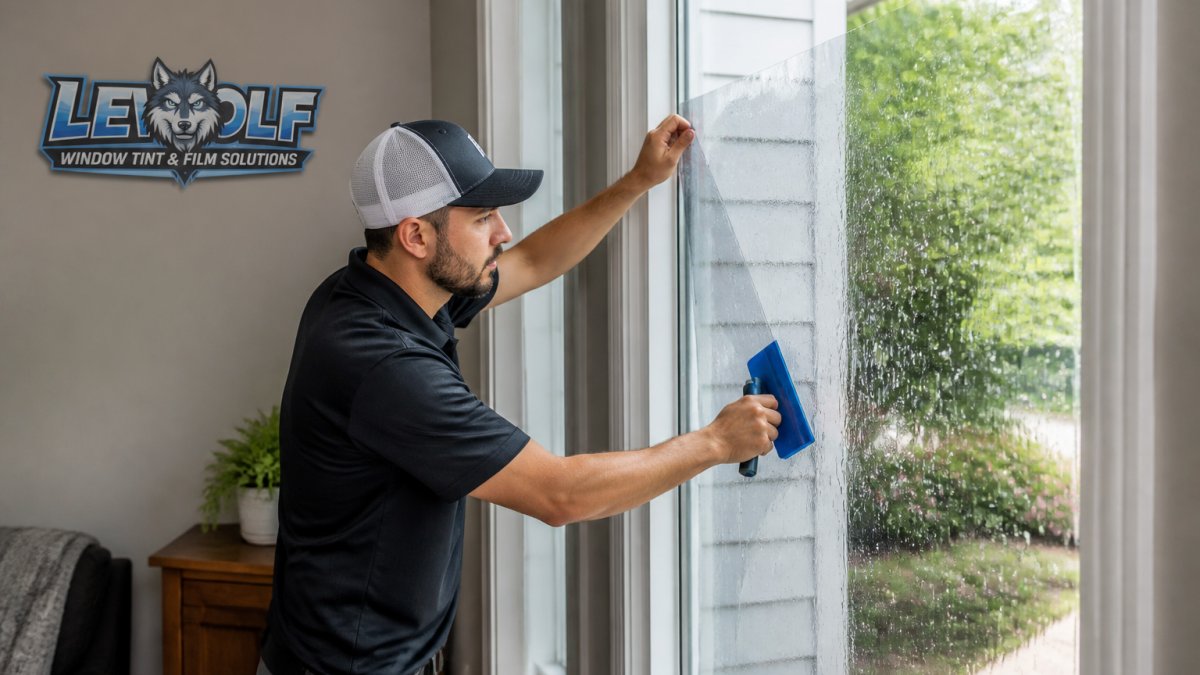
Professional installation ensures proper surface preparation, correct technique, and warranty coverage.
Professional installers also handle complications DIY misses: frames that don't sit flush, curved glass, and multiple-pane windows where film must align across seams. LeWolf Window Tint & Film Solutions backs its work with warranties covering peeling, bubbling, and discoloration.
Installation Timeline and Disruption
Professional installation typically takes 2-4 hours for a standard residential project, depending on window count and film complexity. The process involves removing existing treatments, cleaning the glass, applying the film, and curing.
Many professional installers offer after-hours or weekend installation, and residential customers can schedule at convenient times. The temporary disruption is minimal compared to the years of improved comfort and energy efficiency that follow.
Warranties and Thermal-Stress Risk
Quality films come with manufacturer warranties covering defects, but installation warranty and thermal-stress coverage vary.
Professional installers understand thermal-stress risk and can recommend film types and approaches that minimize it, sometimes advising against certain films on specific windows or suggesting partial-window application. That expertise is part of what you pay for.
Choosing the Right Film for Your Home: Decision Framework
The best residential window film for privacy and heat depends on your climate, room orientation, privacy needs, and aesthetic preferences. Use this framework.
Climate and Solar Exposure Assessment
Homes in hot climates (southern and western states) benefit most from maximum heat rejection films: reflective, dual-reflective, or dark ceramic. Moderate climates can use lighter films that balance heat rejection with natural light.
Room orientation matters equally. South-facing living rooms get intense afternoon heat and benefit from strong heat rejection; north-facing bedrooms get minimal direct sun and need only moderate control. East-facing rooms catch morning sun, west-facing rooms intense afternoon heat.
Privacy Needs vs. Natural Light Preferences
Determine whether you need daytime privacy, nighttime privacy, or both. Bathrooms and bedrooms typically require nighttime privacy, meaning frosted film or supplemental treatments. Living rooms and home offices often need only daytime screening; kitchens may need none.
Balance privacy against natural light. Frosted and opaque films eliminate the view and cut light transmission significantly; daytime privacy films maintain clearer views and higher transmission.
Energy Savings and Payback Period
Residential window film reduces cooling costs by decreasing the heat load on your air conditioning. Savings depend on climate, current cooling costs, and how much of your home you film.
The calculation varies by location and energy prices. Request a professional assessment to estimate actual savings, which helps you prioritize which rooms to film first if budget is a constraint.
Choosing the best residential window film for privacy and heat requires understanding how different films perform and which combination addresses your needs. Our 30 years of experience across residential, automotive, and commercial projects provides valuable insight into how films perform in real conditions over time. Book Now to schedule a consultation and get a professional assessment of which films work best for your home's orientation, climate, and privacy needs.
Frequently Asked Questions
Does one-way window film provide privacy at night?
One-way window film works by exploiting the difference between indoor and outdoor light levels. During the day, the reflective or tinted side faces the brighter exterior, making it difficult to see inside. At night, when interior lights are on, the light from inside reflects off the film and allows people outside to see in. True nighttime privacy requires heavier tints, blackout films, or combining window film with interior window treatments like curtains or blinds for complete coverage.
Which type of window film reduces heat without making a room too dark?
Ceramic window films and lighter-tint reflective films balance heat rejection with visible light transmission (VLT). Ceramic films can reject a significant amount of solar heat while maintaining higher VLT values, keeping rooms bright. Dual-reflective and silver films also perform well for heat reduction while preserving natural light. Choose films with VLT ratings above 50% if maintaining daytime brightness is important; lower VLT ratings (30-40%) provide more privacy and heat control but darken the room.
Can residential window film damage double-pane windows?
Quality residential window film does not damage double-pane windows when installed correctly. However, very dark films or films applied to older, heat-sensitive glass can create thermal stress if the interior pane absorbs too much heat and expands unevenly. This risk is minimized with professional installation, proper film selection for your window type, and avoiding excessively dark films on south- or west-facing windows in hot climates. Warranties from reputable manufacturers typically cover thermal-stress issues.
How much can residential window film reduce cooling costs?
Heat-rejection performance depends on film type, window orientation, and climate. Quality window films can reject a significant amount of solar heat, potentially reducing cooling costs for rooms with significant solar exposure. South- and west-facing windows see the greatest savings. Actual savings vary based on your current cooling system, local climate, existing window insulation, and usage patterns. A professional assessment of your home's solar exposure and current energy use provides the most accurate estimate for your specific situation.
What is the best brand of residential window film?
Top brands include 3M, offering films tested for residential heat reduction, UV protection, and privacy. 3M is recognized for heat-control solutions. The best choice depends on your specific needs: heat reduction priority, privacy requirements, natural light preference, and budget. Professional installers can recommend films suited to your climate, window orientation, and performance goals. Verify certifications and warranties before selecting a brand.