

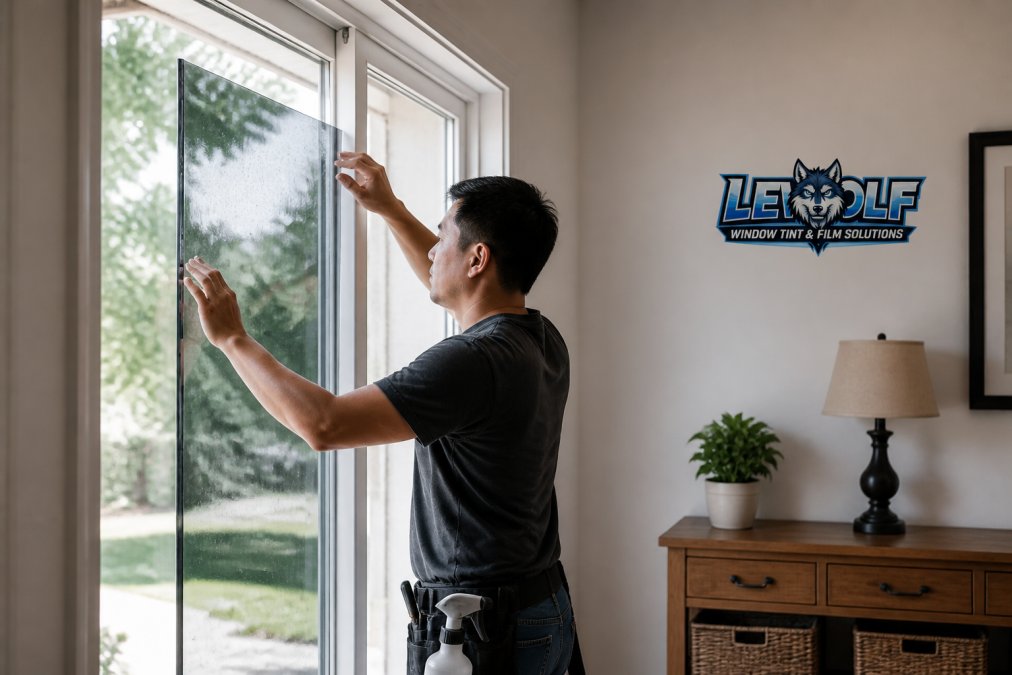
14 min readBy Joshua Leleux
Table of Contents
- How Residential Window Film Energy Savings Actually Work
- Solar Heat Gain Coefficient Window Film: Reading the Spec Sheet
- What You Can Realistically Save on Cooling and Heating
- Window Film vs Replacement Windows: Cost, Payback, and Performance
- Residential Window Film Tax Credit and Rebate Options
- Warranty, Insurance, and Long-Term Film Degradation
- Glare Control, UV Rejection, and Interior Fading Protection
- Professional Installation vs DIY Kits
- Frequently Asked Questions
Last Updated: September 16, 2026
How Residential Window Film Energy Savings Actually Work
Residential window film energy savings come down to one mechanism: the film changes how your glass handles solar heat before that heat ever reaches your living space. At LeWolf Window Tint & Film Solutions, we understand the difference between a well-specified film and a cheap one.
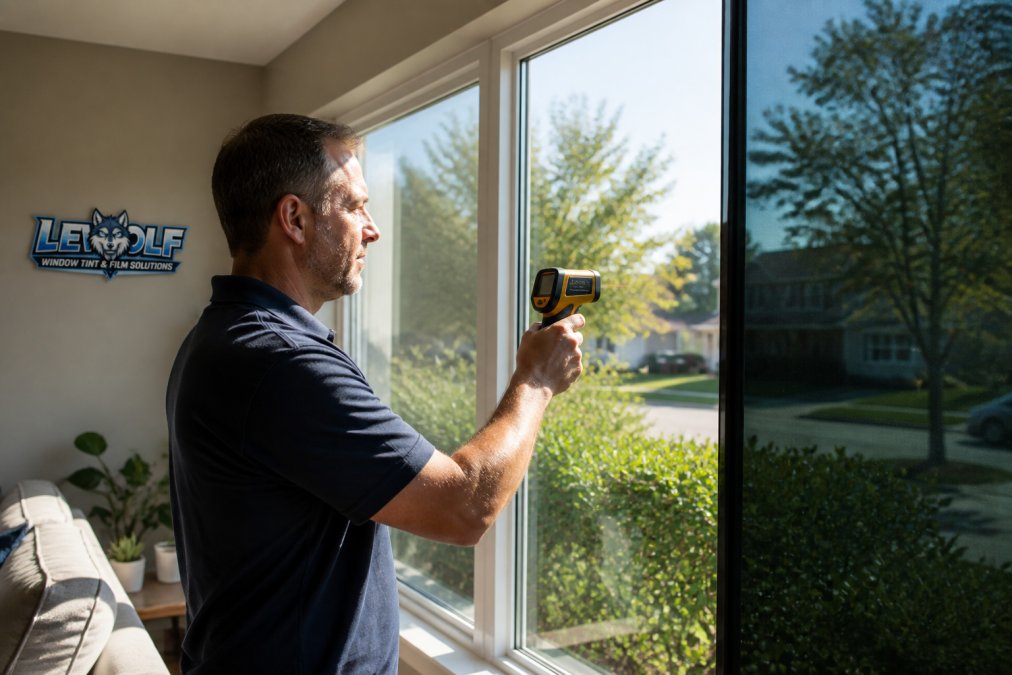
Heat Transfer, Emissivity, and the Numbers That Matter
Heat transfer is the movement of thermal energy from a warmer area to a cooler one, and in window terms it happens three ways: conduction through the glass, convection from air currents, and radiation from absorbed solar energy. Emissivity measures how readily a surface radiates absorbed heat back into a room.
Solar Heat Gain Coefficient Window Film: Reading the Spec Sheet
Solar heat gain coefficient window film performance is defined by one number: SHGC. It measures the fraction of solar energy that passes through your glass as heat, on a scale from 0 to 1. A lower SHGC means less heat enters.
SHGC, VLT, and UV Rejection Compared
Three specs decide whether a film fits your home:
- SHGC (solar heat gain coefficient): Lower blocks more heat. A clear film can still achieve a low SHGC if it's spectrally selective.
- VLT (visible light transmission): Higher keeps rooms brighter. Below roughly 40% starts to feel dim in winter.
- UV rejection: Quality films block nearly all ultraviolet radiation, the primary cause of interior fading.
Ultraviolet rejection and infrared radiation control are where premium films separate from budget options. Optical clarity matters too, especially on large panes where distortion becomes obvious.
| Spec | What It Controls | Target for Hot Climates | Target for Mixed Climates |
|---|---|---|---|
| SHGC | Heat gain | Low | Moderate |
| VLT | Daylighting | Moderate to high | High |
| UV rejection | Interior fading | Maximum | Maximum |
| Emissivity | Winter heat retention | Low | Low |
What You Can Realistically Save on Cooling and Heating
Realistic savings depend on your climate zone, window orientation, and existing glass. Many homeowners find that west- and south-facing rooms see the most noticeable cooling load reduction, since those exposures absorb the most afternoon heat.
Window Film vs Replacement Windows: Cost, Payback, and Performance
Window film vs replacement windows is not a fair fight on upfront cost. Replacement windows carry a window replacement cost several times higher than film, and the payback period stretches over many years.
Retrofit Solutions for Single-Pane and Double-Pane Glass
Single pane vs double pane performance changes which film you choose. Single-pane glass benefits enormously from film because it has almost no inherent insulating properties. Double-pane glass already traps air between panes, so film adds heat rejection rather than insulation.
Residential Window Film Tax Credit and Rebate Options
The residential window film tax credit question trips up more homeowners than any other part of this decision, because the answer is genuinely conditional. Window film is not automatically a qualifying improvement the way a new furnace or a solar array is. Whether you can claim anything depends on which program applies, what the film's rated specs are, and how your installer documents the work.
The Federal Credit Framework
The main federal lever is the Energy Efficient Home Improvement Credit, commonly referenced by its tax code section, 25C (Energy Efficient Home Improvement Credit). It covers a defined list of envelope and systems improvements, insulation, air sealing, doors, windows, and certain HVAC equipment, and sets annual percentage caps on what you can claim.
Where Rebates Actually Show Up
Utility and state programs are where film has a more realistic path, though it is still inconsistent. Some municipal utilities and rural electric cooperatives run weatherization or demand-reduction rebates that list window film as an eligible measure, particularly in hot-climate service territories where peak cooling load is the utility's real problem. Others list only window replacement.
What Your Installer Should Hand You
If a program does apply, the paperwork is what gets you paid. Ask your installer for:
- The manufacturer's spec sheet showing rated SHGC, VLT, and UV rejection values for the exact product installed
- A signed invoice that names the product, the square footage treated, and the installation date
- The manufacturer's warranty document, since some rebate administrators require proof of a multi-year warranty
- Any certification or dealer authorization the manufacturer issues for the installing company
Verify Before You Commit
Check current federal incentive language through the Department of Energy's energy savings resources and confirm utility rebates directly with your provider, since program terms change annually and vary by service territory. A reputable installer will tell you plainly when film does not qualify, and that honesty is worth more than a rebate that never arrives.
Warranty, Insurance, and Long-Term Film Degradation
Most guides stop at the savings estimate. The questions that actually decide whether film is a good long-term investment are the ones homeowners ask after the install: will it last, will it void my window warranty, and what happens if something goes wrong. Here is the honest version.
How Film Actually Degrades
Film failure is rarely sudden. It follows a predictable sequence driven by adhesive chemistry, film thickness, and UV exposure.
- Years 1-3: A quality film looks unchanged. Cheap films may show a faint haze or a slight color shift as the dye layer reacts to UV.
- Years 3-7: Adhesive edges begin to lift on poorly prepped glass. On low-grade dyed films, a purple or bronze cast develops as the dye breaks down, this is a dye failure, not a dirt problem, and it cannot be cleaned off.
- Years 7-12: Metallized and ceramic films typically hold up well past a decade. Dyed films often need replacement by this point. Edge lifting accelerates in high-heat exposures like west-facing glass in hot climates.
The Window Warranty Question Nobody Answers
This is the risk most guides skip. Applying film to Low-E glass or to a sealed double-pane unit can, in some cases, void the window manufacturer's warranty.
Historic and Specialty Glass
Historic windows present a different problem. Original single-pane glass in older homes is often thinner and more brittle than modern glass, and some historic districts restrict exterior alterations. Interior film is usually the workable path, but the film must be low-stress and removable without damaging the glass or the glazing putty.
Insurance Implications
Standard homeowner policies do not usually care about decorative or solar film. Security film is different. Because it holds glass together under impact, some insurers treat it as a mitigation measure and may reflect it in premiums or in claim handling for break-in or storm damage. Others treat it as a modification that must be disclosed.
What a Real Warranty Covers
Manufacturer warranties on residential film typically run from five to fifteen years depending on product line, and they generally cover defects, bubbling, delamination, discoloration, but not labor to remove and reapply. Some installers add their own labor warranty on top. Ask three questions before you buy: How long is the manufacturer's warranty? Does it cover labor? What voids it?
Glare Control, UV Rejection, and Interior Fading Protection
Glare control is the benefit homeowners notice first. Daylighting stays usable without the harsh wash that makes screens unreadable and rooms uncomfortable. Thermal comfort improves because the radiant heat hitting your skin is reduced.
Professional Installation vs DIY Kits
DIY kits look tempting. In practice, professional installation determines whether the film performs as rated. Trapped dust, air bubbles, and uneven adhesive contact all degrade performance and appearance.
Frequently Asked Questions
Does window film really help with energy efficiency?
Yes, when the film is spectrally selective. A quality film lowers the solar heat gain coefficient of the glass, which cuts how much solar heat enters the room and reduces the cooling load on your HVAC system. It also adds a small amount of thermal insulation by lowering emissivity, which helps hold heat inside during winter. The size of the benefit depends on your climate zone, window orientation, and how much glass you have. Homes with large west- or south-facing single-pane windows see the biggest change.
How much can I expect to save on energy bills with window tint?
Savings vary widely by climate zone, window type, and film chosen, so treat any single percentage as a rough guide rather than a promise. The variables that move the number most are your solar heat gain coefficient, the square footage of treated glass, and how hard your air conditioner already works. A professional assessment can estimate kilowatt-hour savings for your specific home. LeWolf Window Tint & Film Solutions can provide a realistic projection instead of a generic figure.
Is there a residential window film tax credit available?
Federal incentives for home energy improvements have shifted in recent years, and window film has not consistently qualified under the main residential efficiency programs. Some utility rebates and state-level programs do cover qualifying film installations, particularly in hot climate zones. Because rules change, check the current Database of State Incentives for Renewables & Efficiency and your utility's rebate page before you buy. Keep your invoice and film spec sheet, since most programs require documentation of the SHGC and UV rejection ratings.
Is professional window film installation worth the cost compared to DIY kits?
Professional installation matters most on large panes, dual-pane glass, and low-E windows, where trapped moisture or a poor seal can void the glass manufacturer's warranty. A certified installer also knows which film is compatible with your specific window type, which is where most DIY failures happen. DIY kits can work on small, single-pane windows in low-stakes rooms. For whole-home projects or anything with a warranty at stake, the labor cost usually pays for itself in fewer bubbles, no peeling, and a film warranty you can actually use.
Your windows are either working for your energy bill or against it, and most homes lose that fight every summer afternoon. LeWolf Window Tint & Film Solutions brings 30 years of experience, 3M certification, and a 5.0 Google rating to every residential project, from single-pane retrofits to full-home installations. Book your assessment and get film specified for your actual glass, not a generic package.