
12 min readBy Joshua Leleux
Table of Contents
- Full Front End PPF Cost: Real Price Ranges by Vehicle
- What Does Full Front PPF Include?
- Full Front vs Partial Front PPF: Coverage and Cost Comparison
- Factors That Move Your Full-Front PPF Quote Up or Down
- How Long Does PPF Installation Take?
- Is Front-End PPF Worth It? Long-Term Value and Alternatives
- How to Compare Full-Front PPF Quotes and Avoid Red Flags
- Frequently Asked Questions
Last Updated: October 17, 2026
Full Front End PPF Cost: Real Price Ranges by Vehicle
Full front end PPF cost typically falls between $1,200 and $3,500 for most vehicles, based on published installer pricing across the industry. The exact figure depends on your vehicle's size, the film you choose, and how much of each panel gets covered.
Here's the uncomfortable truth: most quotes you'll see online are useless until you know what they include. A $1,200 quote and a $2,800 quote can describe completely different jobs. At LeWolf Window Tint & Film Solutions, we can tell you the spread comes from coverage, film grade, and prep work, not just markup.
Published pricing from Exclusive Paint Protection's PPF cost guide puts full-front PPF at $1,200-$2,500 for sedans and sports cars, and $1,400-$3,000 for SUVs and trucks. Larger, boxier front ends mean more film and more labor.
| Vehicle Type | Typical Full-Front PPF Range |
|---|---|
| Sedan / sports car | $1,200 - $2,500 |
| SUV / truck | $1,400 - $3,000 |
| Full vehicle | $4,000 - $8,000+ |
What Does Full Front PPF Include?
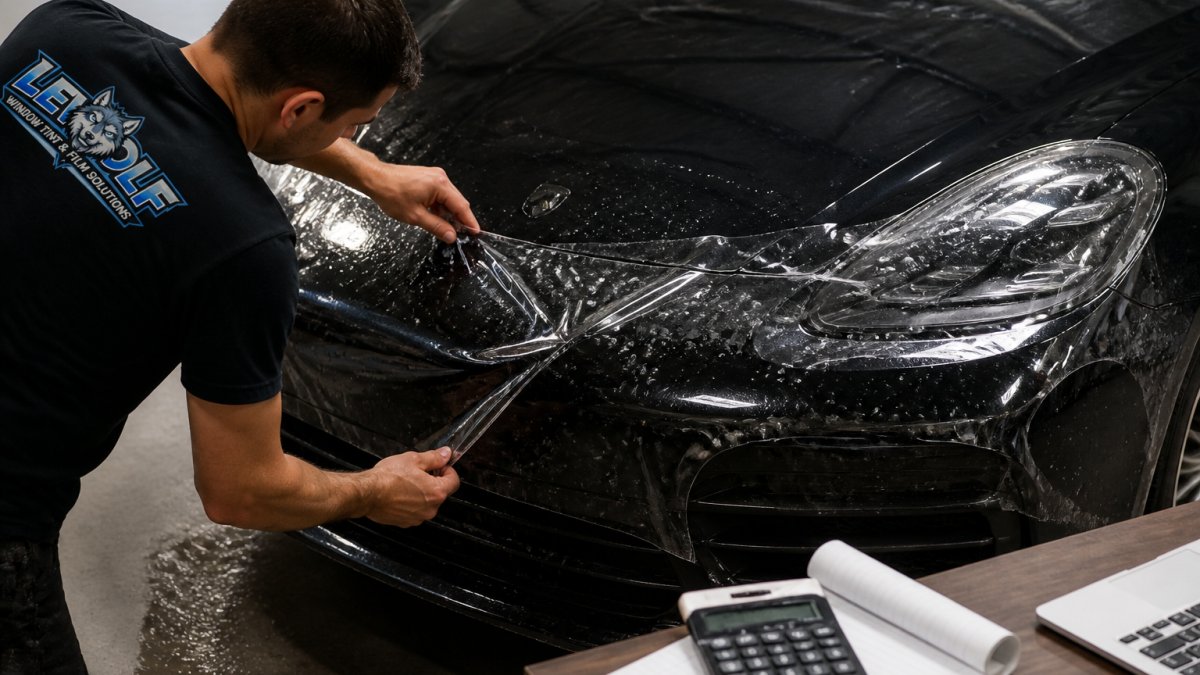
Full-front PPF covers the front bumper, full hood, front fenders, side mirrors, and headlights. It is a defined coverage package, not a vague "front end" promise, and the panel list is what separates a real full-front quote from a partial one dressed up as full coverage.
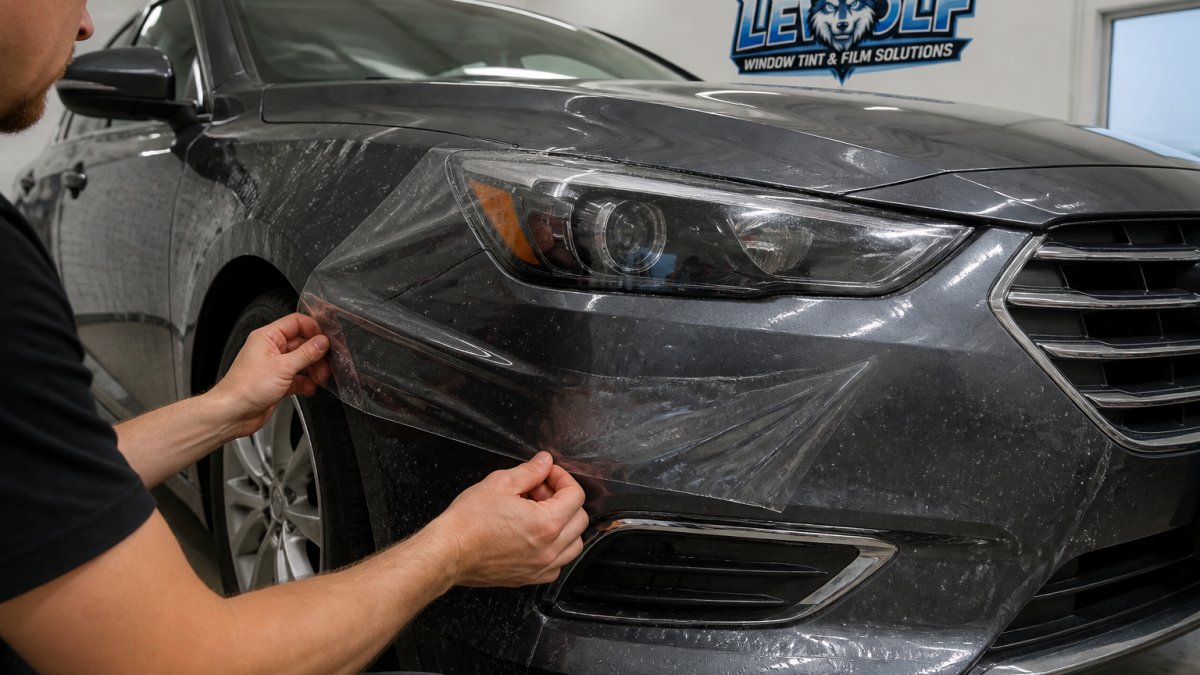
A true full-front package includes:
- Full front bumper, wrapped around edges where possible
- Full hood, not just a partial strip
- Both front fenders, full panel
- Side mirrors
- Headlights
Some shops add a strip on the roof or A-pillars as a "track package." Ask before you assume it's included.
Full Front vs Partial Front PPF: Coverage and Cost Comparison
Partial-front PPF covers roughly the first 18 to 24 inches of the hood, fenders, and bumper, and costs about $600-$1,500. Full-front coverage protects the entire hood and fenders, which is why it runs $1,500-$3,500.
Aaron's Automotive Detailing's PPF pricing breakdown confirms this split, listing partial-front at $600-$1,500 and full-front at $1,500-$3,500.
The trade-off is simple. Partial coverage handles the highest-impact zones: the bumper lip, the leading edge of the hood, and the mirror caps. Full-front adds the rest of the hood and fenders, which is where road debris from highway driving tends to land at speed.
| Coverage | Panels Protected | Typical Range |
|---|---|---|
| Partial front | Bumper, hood strip, fender strips | $600 - $1,500 |
| Full front | Full bumper, full hood, full fenders, mirrors, headlights | $1,500 - $3,500 |
| Full vehicle | Every painted panel | $4,000 - $8,000+ |
For a daily driver that sees highway miles, full-front is the coverage level most owners end up wishing they'd bought. For a weekend car kept in a garage, partial-front often makes more financial sense.
Factors That Move Your Full-Front PPF Quote Up or Down
Vehicle size is the biggest driver of front end PPF cost. A Tesla Model 3 and a Rivian R1T use very different amounts of film, and published estimates reflect that gap. BGI Tint's PPF cost guide notes full-vehicle coverage alone can run $4,000-$8,000 or more, which shows how quickly panel count adds up.
But size only explains part of the spread. The most useful way to understand a full-front quote is to break it into the line items a shop actually prices. Most practitioners structure a full-front bid around five components:
- Film material. Entry-level film versus premium self-healing film with a longer warranty. Film is usually the smallest line item on a full-front job, which is why a cheap film rarely explains a cheap quote on its own.
- Labor hours. Film application time scales with panel complexity. A wrapped bumper with fog light recesses and parking sensors takes longer than a flat hood, and shops price labor by the hour or by a panel-specific flat rate.
- Panel removal and reassembly. Removing headlights, mirrors, badges, and bumper trim lets installers wrap edges cleanly, but it adds labor and the risk of broken clips. Ask whether removal is included or billed separately.
- Edge wrapping. Wrapped edges take more time but look cleaner and hold up better. A quote that cuts film short at panel gaps will be cheaper and will also be more visible up close.
- Prep work. Paint decontamination, clay bar, and paint correction before installation add labor and cost. Skipping prep is the most common reason a cheap install fails early.
A sample apples-to-apples breakdown for a mid-size sedan full-front job often looks like this in structure (your shop's numbers will differ):
| Line Item | What It Covers | How It Shows Up in a Quote |
|---|---|---|
| Film | Full bumper, hood, fenders, mirrors, headlights | Priced by panel or by square footage |
| Labor | Application hours across all panels | Hourly rate or flat per-panel rate |
| Panel removal | Lights, mirrors, trim, badges | Included or added as a separate line |
| Edge wrapping | Wrapped versus trimmed edges | Often bundled into labor, sometimes separate |
| Prep | Wash, decontamination, clay, correction | Included or priced as an add-on |
When you compare bids, put them side by side in that structure. Two quotes with the same total can describe very different jobs once you see which lines are included, which are add-ons, and which are missing entirely.
Regional labor rates also move the number. Metro shops charge more than rural ones for the same job, and installer availability in your area affects both price and scheduling. The next section covers how to separate a local estimate from a national range.
How Long Does PPF Installation Take?
Full-front PPF installation typically takes one full day, and often two if paint correction or edge wrapping is involved. Partial-front jobs usually finish in a few hours.
The timeline breaks down roughly like this:
- Wash and decontamination: 1-2 hours
- Paint correction, if needed: 2-6 hours
- Film application: 3-5 hours
- Curing and final inspection: same day to 24 hours Achieving a flawless surface before the film is applied often requires professional machine polishing to remove deep swirls and imperfections that standard decontamination cannot address.
Plan to leave the vehicle. Rushing a film install is how you get trapped moisture, lifted edges, and bubbles that never settle.
Is Front-End PPF Worth It? Long-Term Value and Alternatives
Front-end PPF is worth it if you plan to keep the vehicle and care about resale value, because rock chips and paint damage are expensive to correct and hard to hide. A respray of a front bumper and hood can cost more than the film itself.
Compare it to alternatives honestly. Ceramic coating adds gloss and makes washing easier, but it does not stop rock chips. Wax offers no chip protection at all. PPF is the only option in this comparison that physically absorbs impact from road debris.
The math favors PPF on vehicles driven daily on highways, on dark paint colors that show every chip, and on anything with resale value worth protecting. On a leased commuter car you'll turn in next year, the value case is weaker.
How to Compare Full-Front PPF Quotes and Avoid Red Flags
Compare full-front PPF quotes line by line, not by total price. The lowest bid is often missing prep work, edge wrapping, or a real warranty, and that gap shows up two years later as peeling film.
Start by separating a local estimate from a national range. National ranges like $1,200-$3,500 describe the market broadly; your local quote reflects labor rates, installer availability, and demand in your area. A common pattern is that metro labor rates run higher than rural ones for the same panel count, and shops with long waitlists may price accordingly.
Use this checklist when you collect quotes:
- Does the quote list every panel by name?
- Is the film brand and product line stated?
- Is paint correction included or priced separately?
- Are edges wrapped or cut short?
- Is panel removal included or billed separately?
- What is the warranty length, and does it cover labor?
- Is the installer certified by the film manufacturer?
- Does the shop have a clean, dust-controlled bay?
Then judge installation quality before you judge price. Ask to see a completed full-front job in person and check the fit and finish: edges should be wrapped or trimmed consistently, seams should be minimal and placed where they are least visible, and there should be no trapped contamination, bubbles, or lifted edges. A shop that cannot show you finished work is a risk regardless of price.
Warranty support matters as much as warranty length. A warranty that covers materials but not labor leaves you paying for removal and reinstallation if the film fails. Ask who honors the warranty, whether it is tied to the film manufacturer or the shop, and what documentation you receive at pickup. Film lifespan and care requirements belong in the same conversation: most quality films are expected to last many years with proper care, and maintenance costs are low but not zero.
Red flags worth walking away from: a quote that won't name the film, a warranty that only covers materials, a shop that promises same-day turnaround on a full-front job with no prep, and any bid that cannot explain what happens if an edge lifts.
At LeWolf Window Tint & Film Solutions, we're a 3M Authorized Dealer and 3M Certified, and we walk every customer through the exact panel list before installation. That transparency is the whole point. You should know what you're buying before the film touches your paint.
Frequently Asked Questions
Is a PPF front end worth it?
For most drivers, full-front PPF is worth it if you plan to keep the vehicle for several years or drive on highways where rock chips are common. Published full-front PPF cost ranges from $1,200 to $3,500, which is often less than repainting a hood and bumper. The film also preserves resale value by keeping the original paint intact. If you lease or trade in every two years, partial-front coverage may be a better fit.
How long does a full front PPF take?
A full-front PPF installation typically takes one to two days. The front bumper, full hood, fenders, mirrors, and headlights require careful preparation, pattern cutting, and edge wrapping. Complex curves on SUVs and trucks can add time. Some shops keep the vehicle overnight to let the film settle and to inspect edges. Ask your installer for a realistic timeline before you drop off the car.
Is PPF overpriced?
PPF pricing reflects film quality, installer skill, and warranty support, not just material. Published full-front PPF cost ranges from $1,200 to $3,500, and the low end often uses thinner film or simpler patterns. A quote that is several hundred dollars below local averages may skip paint correction, edge wrapping, or a real warranty. Compare itemized quotes rather than the bottom-line number.
What factors affect the cost of front-end PPF?
Vehicle size and shape, film brand and thickness, coverage package, paint condition, and installer labor rates all affect front-end PPF cost. Trucks and SUVs use more film and take longer to install than sedans. Premium self-healing film costs more than entry-level clear film. If your paint needs correction before installation, expect an added charge. Regional labor rates also shift quotes by hundreds of dollars.
How does full-front PPF compare with partial-front PPF?
Partial-front PPF covers the bumper, partial hood, and partial fenders, while full-front PPF adds the full hood, full fenders, side mirrors, and often headlights. Published partial-front pricing runs $600 to $1,500, compared with $1,200 to $3,500 for full-front coverage. Full-front costs more but protects the entire leading edge of the vehicle, which is where most road debris strikes.
Full-front PPF pricing varies for a reason, and the cheapest quote is rarely the best value once you account for prep, film quality, and warranty coverage. If you want a straight answer on what your vehicle needs, LeWolf Window Tint & Film Solutions offers 30 years of installation experience, 3M certification, and a panel-by-panel breakdown before you commit. Book now and get a quote built around your actual vehicle, not a generic range.