
14 min readBy Joshua Leleux
Table of Contents
- Why Storefront Glass Is a Target for Break-Ins
- How Security Window Film Works on Storefront Glass
- Security Window Film Thickness Guide for Storefronts
- Commercial Glass Safety Ratings Explained
- How to Prevent Smash and Grab Robberies at Your Store
- Retrofitting vs. Replacing Storefront Glass
- Installation, Maintenance, and Insurance Considerations
- Frequently Asked Questions
Last Updated: September 14, 2026
Why Storefront Glass Is a Target for Break-Ins
Security window film for storefront glass is a thin, transparent layer bonded to existing panes to hold glass together during impact, delay forced entry, and block UV light. At LeWolf Window Tint & Film Solutions, we've installed this film on storefronts, campuses, and commercial properties for years, and the pattern never changes: glass is the weakest point in the building envelope.
A smash-and-grab takes seconds. The thief breaks the pane, grabs what's within arm's reach, and is gone before police arrive. According to FBI Uniform Crime Reporting Program, burglary remains one of the most common property crimes in the country, and retail storefronts absorb a disproportionate share.
The Real Cost of a Smash-and-Grab
The stolen merchandise is rarely the biggest loss. Storefront owners deal with:
- Replacement glass, often a rush order at premium cost
- Business interruption while the storefront is boarded up
- Insurance deductibles and premium increases after a claim
- Lost customer trust when a damaged storefront sits visible for days
Treating glass as a fixed cost is a mistake, it's a recurring vulnerability until reinforced.
How Security Window Film Works on Storefront Glass
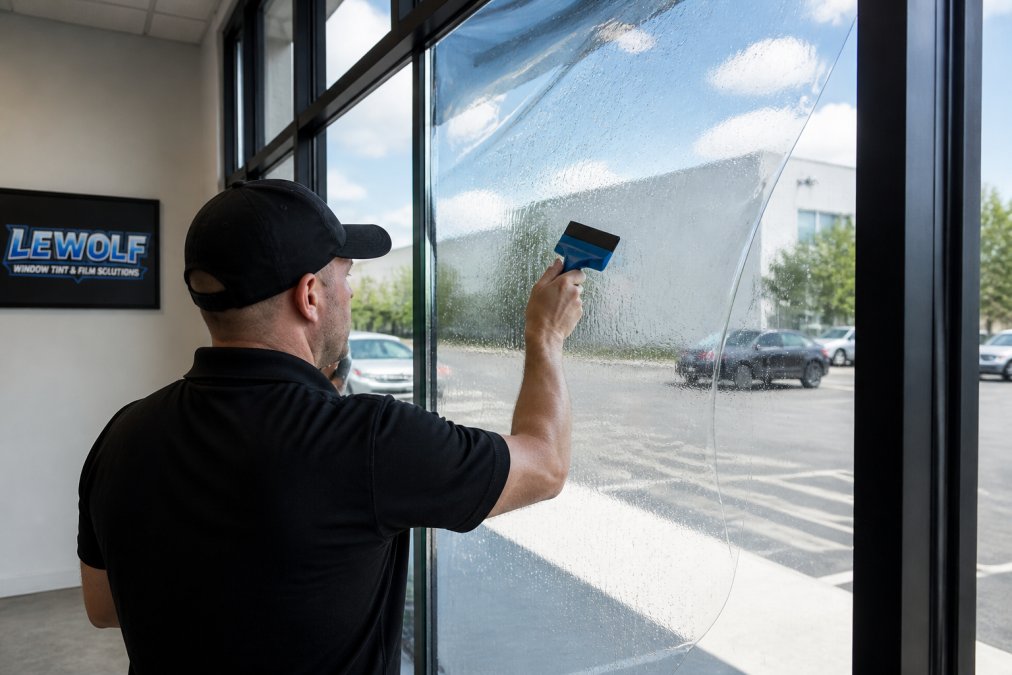
Security film bonds to the glass with a high-strength adhesive, so when the pane breaks, the film holds the fragments in place instead of letting them fall away. The glass may crack, but it stays in the frame.
Fragment Retention and the Adhesive Bond
Fragment retention is the film's core job: keeping glass shards together after impact. The adhesive bond is what makes it work. Cheap films peel at the edges within a year; quality films with a strong adhesive and a scratch-resistant coating hold for a decade or more.
Two structural details matter:
- Attachment systems. For higher-security applications, installers add a structural sealant or mechanical attachment at the frame edge. This anchors the film to the frame, not just the glass, and dramatically improves forced-entry resistance.
- Glass type. Tempered glass shatters into small cubes; laminated glass already holds together. Security film behaves differently on each, which is why a site assessment comes before a quote.
Security Window Film Thickness Guide for Storefronts
Thickness is measured in mils (thousandths of an inch) and is the single biggest factor in how much punishment a pane can take. But adhesive chemistry, attachment system, and glass type all interact with thickness to determine real-world performance. Here's how the common options compare:
| Film Thickness | Best For | Typical Break-In Delay | Attachment System Needed? | Notes |
|---|---|---|---|---|
| 4 mil | Light deterrence, vandalism, accidental impact | Seconds | No | Entry-level; clear optical quality; often used on interior glass |
| 7-8 mil | Most retail storefronts, restaurants, small retail | Meaningful delay (often 30-60 seconds against blunt force) | Recommended on ground-floor glass | Best balance of cost, clarity, and protection |
| 11-14 mil | Jewelry stores, pharmacies, cannabis dispensaries, high-value retail | Maximum delay; can exceed several minutes with proper anchoring | Yes, structural sealant or mechanical attachment | Thickest; heaviest; requires experienced installers |
4 Mil vs. 8 Mil vs. 14 Mil: What to Choose
4 mil is the entry point. It handles accidental impact and light vandalism, but a determined thief with a tool will get through. It suits interior partitions, upper-floor windows, or low-crime storefronts where the goal is fragment retention rather than forced-entry delay.
7-8 mil is what most commercial installers recommend for ground-floor storefronts. On annealed glass, an 8 mil film with a proper attachment system can turn a two-second smash-and-grab into a 30-to-60-second struggle, long enough for an alarm response or a witness to call police, and long enough that most opportunists move on.
11-14 mil is for jewelry stores, pharmacies, dispensaries, and any location with a documented break-in history or high-value inventory visible from the street. It's heavy, requires a structural attachment system, and costs more, but it's the closest thing to a security-grade barrier you can add to existing glass without full replacement.
Why Thickness Alone Isn't Enough
A common mistake is assuming thicker is always better. On tempered glass, a very thick film without proper edge anchoring can pop out of the frame as a single sheet, leaving the opening just as wide as before. On laminated glass, which already holds together, film is often about UV and scratch protection more than forced-entry resistance.
The variables that matter alongside thickness:
- Glass type. Annealed, tempered, and laminated glass each behave differently under impact. A site assessment should identify which you have before a thickness is recommended.
- Frame condition. Film anchors to the frame, not just the glass. A rotting or loose frame undermines even a 14 mil installation.
- Attachment method. Wet-glaze structural sealant, mechanical retention, or a combination, the attachment keeps the film-and-glass assembly in the opening after impact.
- Threat profile. A quiet suburban storefront and a downtown pharmacy face different risks. Match the film to the actual threat, not the marketing sheet.
Thickness and Insurance Documentation
If your goal is to satisfy an insurer or code official, mil thickness is only part of what they'll want to see. Most look for documentation showing how the film-plus-glass assembly performs as a system, not just the film's spec sheet. Ask your installer for:
- The film manufacturer's product data sheet, including mil thickness and adhesive type.
- The attachment system specification, including the structural sealant or mechanical retention method.
- Any third-party test documentation showing the assembly's performance under impact.
A film that improves safety performance does not automatically re-rate the glass itself, the single most common point of confusion in commercial installations.
Commercial Glass Safety Ratings Explained
Commercial glass safety ratings tell you how a glazing product performs under impact, and they're the language insurers and building inspectors use. In the US, look for ANSI Z97.1 (safety glazing performance) and CPSC 16 CFR 1201 (federal safety standard for architectural glazing) (CPSC Amends Mandatory Safety Standard for Architectural Glazing Materials). For security-specific performance, the benchmarks are ASTM F1233 (forced-entry resistance) and ASTM F1642 (blast mitigation) (Security System Standards Pedestrian and Walkway Safety Standards - Standards Products...).
What most guides miss: a film can improve safety performance without the glass itself being re-rated. Ask your installer for documentation showing how the film-plus-glass assembly performs, not just the film's spec sheet.
How to Prevent Smash and Grab Robberies at Your Store
Preventing smash and grab robberies comes down to layering deterrents so the storefront is a harder target than the one down the street. Film is one layer. Here's the full stack:
- Apply security film to all street-facing glass, including doors.
- Add an attachment system on high-value display windows.
- Install visible security cameras and signage. Deterrence starts before entry.
- Use interior display locks so high-value items aren't reachable through broken glass.
- Set up an alarm with glass-break detection so response starts the moment impact happens.
- Keep the storefront well-lit at night. Dark glass is an invitation.
- Train staff on closing procedures: clear displays, lock cases, verify the alarm.
None of these work alone. Together, they push a would-be thief toward an easier target.
Retrofitting vs. Replacing Storefront Glass
Retrofitting security film onto existing glass costs a fraction of full glass replacement and can typically be done after hours so your business doesn't lose a day. Replacing glass with laminated or security-grade panes is stronger long-term, but it's disruptive, expensive, and often unnecessary if the current glass is sound.
The decision usually comes down to three questions:
- Is the existing glass sound? If it's cracked, fogged, or failing, replace it first.
- What's the threat level? A quiet suburban storefront and a downtown pharmacy face different risks.
- What's the budget and timeline? Retrofit is faster and cheaper; replacement is more permanent.
For most storefront owners, retrofit is the right first move. It delivers most of the protection at a fraction of the cost, and it can be upgraded later.
Installation, Maintenance, and Insurance Considerations
Most guides stop at installation. The real-world questions storefront owners ask six months later are about maintenance, warranty, and whether the film actually affects their insurance.
What a Proper Installation Actually Involves
Installation is where cheap jobs fall apart. A proper commercial install follows a sequence that takes longer than most owners expect:
- Site assessment. Identify glass type (annealed, tempered, or laminated), frame condition, and any existing damage.
- Glass preparation. Clean the glass thoroughly and remove contaminants, skipping this is the leading cause of premature peeling.
- Film cutting. Cut to size with a margin for trimming after application.
- Application. Apply with a slip solution, squeegee out air and moisture, and trim edges cleanly.
- Attachment system (if specified). Apply structural sealant or mechanical retention at the frame edge for higher-security installations.
- Cure. Cure runs several days to a few weeks depending on humidity; small bubbles and haze are normal and clear on their own.
For storefronts, installation is typically scheduled after hours or on a closed day so the business doesn't lose revenue. Ask your installer how they handle scheduling and whether they provide a written cure-time guideline.
Maintenance: How to Make Film Last 10+ Years
Security film is not maintenance-free. Most quality films carry a 5-10 year manufacturer warranty, often conditional on proper care. The routine is simple but not optional:
- Clean with a soft cloth and a mild, ammonia-free cleaner. Ammonia-based cleaners can degrade the adhesive over time.
- Avoid abrasive pads, razor blades, and scrapers near the edges. Edge damage is the most common cause of premature failure.
- Inspect edges every few months for lifting. Small lifts spread quickly, especially in high-temperature or high-humidity environments.
- Address peeling promptly. A small lift re-adhered early is a minor service call; a large lift ignored becomes a full re-install.
- Watch for haze or discoloration. Some haze during the first few weeks is normal cure behavior; persistent haze after cure may indicate a defective film or installation issue.
Storefronts in direct afternoon sun or climates with wide temperature swings see faster edge wear than shaded or climate-controlled interiors. If your storefront faces those conditions, budget for a professional inspection every year or two.
Insurance and Legal Implications
Whether security film affects your insurance or legal obligations depends on your carrier, policy, and local building codes, but there are patterns worth knowing.
Insurance. Many commercial property policies reward documented security improvements, but specifics vary by carrier and policy form. Some offer premium discounts for verified upgrades; others simply note the improvement. The key is documentation: a written installation record, the film manufacturer's product data sheet, and the attachment system specification. Talk to your agent before installation so you know what they'll want.
Building codes. Some jurisdictions require safety glazing near doors, in sidelights, and in low windows, and film can sometimes bring existing glass into compliance without full replacement. The relevant benchmarks are ANSI Z97.1 (safety glazing performance) and CPSC 16 CFR 1201 (federal safety standard for architectural glazing); for security-specific performance, ASTM F1233 (forced-entry resistance) and ASTM F1642 (blast mitigation). A film can improve safety performance without the glass itself being re-rated, a distinction that matters when you're talking to a code official.
Lease and tenant obligations. If you lease your storefront, check your lease before installing film. Some landlords require written approval for alterations to the glass or frame, and some commercial leases specify who handles glass maintenance and repair. Written approval protects your security deposit and avoids disputes at renewal.
Warranty and liability. If the film is part of a security system advertised to customers or required by an insurer, the installation record becomes part of your risk documentation. Keep it with your insurance files and update it if you change carriers.
For schools and public facilities, security film is often specified under campus safety planning, and manufacturer-authorized dealers frequently work with school districts on these projects. Documentation requirements there are typically stricter than in retail, so the same records that satisfy a school district will more than satisfy a commercial insurer.
Frequently Asked Questions
Does security window film actually work against forced entry?
Yes. Security window film works by holding glass fragments together when the pane breaks. The film's adhesive bond and tensile strength keep the glass in the frame, so a burglar can't simply smash a hole and reach through. The thicker the film, the longer it resists. For storefronts, 8 mil or 14 mil film is common. It won't make glass unbreakable, but it turns a 5-second break-in into a 30-second struggle, which is usually enough to send thieves elsewhere.
What thickness of security window film is recommended for commercial storefronts?
Most storefronts use 8 mil to 14 mil film. An 8 mil film handles everyday smash-and-grab attempts and accidental impacts. A 14 mil film is better for high-risk areas or glass near door frames where forced entry is more likely. Your security window film thickness guide should match the glass type and the level of risk. LeWolf can assess your storefront and recommend the right mil thickness for your situation.
How long does security window film last on storefront glass?
Quality security film from a 3M authorized dealer typically lasts 10 to 15 years on storefront glass. Longevity depends on sun exposure, cleaning habits, and installation quality. Film with a scratch-resistant coating holds up better to daily wear. Proper curing time after installation matters too. LeWolf's certified installers use professional-grade film and back it with warranty coverage.
Does insurance cover security window film for storefronts?
Some commercial insurance policies offer premium discounts for security window film because it reduces break-in risk and glass damage claims. Coverage varies by carrier and policy. Check with your insurance agent about whether film qualifies for a discount. LeWolf can provide documentation of the film's safety ratings and installation specs to support your claim.