
13 min readBy Joshua Leleux
Table of Contents
- Paint Protection Film vs Vinyl Wrap: The Core Difference
- Material Composition: Thermoplastic Polyurethane vs Polyvinyl Chloride
- Automotive Paint Protection Film Cost Guide
- How Long Does Vinyl Wrap Last on a Car?
- Paint Protection Film vs Ceramic Coating
- Hybrid Solutions: Color PPF and Layered Setups
- Resale Value, Removal, and Environmental Impact
- Frequently Asked Questions
Last Updated: September 12, 2026
Paint Protection Film vs Vinyl Wrap: The Core Difference
The paint protection film vs vinyl wrap decision comes down to one question: are you buying armor or a wardrobe? Paint protection film is a transparent, thick urethane layer built to absorb rock chips and road debris while leaving your factory paint visible. A vinyl wrap is a thinner, colored film that changes how your car looks. At LeWolf Window Tint & Film Solutions, we address the confusion drivers often have, assuming they're shopping for the same product in two finishes. They aren't. One is surface protection, the other is automotive aesthetics, and only a small overlap exists between them.
What Paint Protection Film Actually Does
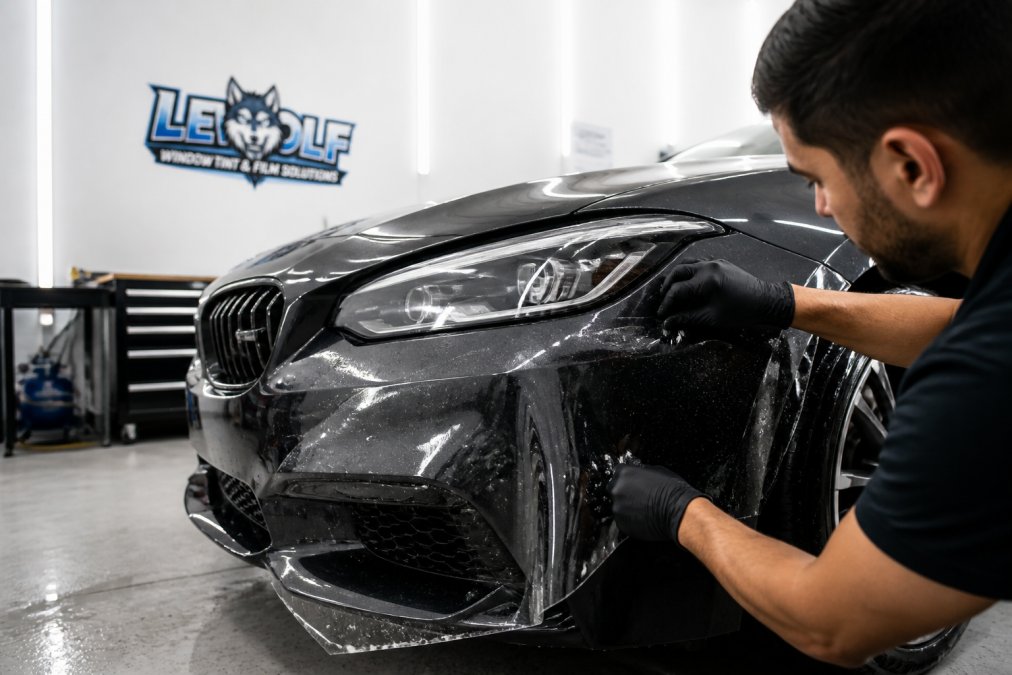
Paint protection film, often called clear bra, is a transparent urethane layer applied over your existing paint. It absorbs impact from rock chips, resists chemical staining from bird droppings and road tar, and many premium films carry self-healing properties that let light scratches vanish with heat. It preserves your paint depth and gloss finish because it sits on top of them invisibly.
What a Vinyl Wrap Actually Does
A vinyl wrap is a colored or textured film that covers your paint to change its appearance entirely. Matte finish, satin finish, gloss, carbon fiber texture, color-changing films: the range is the point. What it does not do is absorb impact. A common mistake is expecting a wrap to stop rock chips on a daily driver. It won't. The film is too thin for that job, and chips punch straight through to the paint underneath.
Material Composition: Thermoplastic Polyurethane vs Polyvinyl Chloride
The material gap explains everything else. Paint protection film is built from thermoplastic polyurethane, a flexible, impact-resistant polymer typically sold in 8 mil thickness or more. Vinyl wrap uses polyvinyl chloride, a thinner film, usually 2 to 4 mil, engineered for conformability and color rather than impact resistance (PubMed). That single difference in chemistry and thickness drives durability, cost, and lifespan.
| Feature | Paint Protection Film | Vinyl Wrap |
|---|---|---|
| Base material | Thermoplastic polyurethane | Polyvinyl chloride |
| Typical thickness | 8 mil and up | 2-4 mil |
| Primary purpose | Surface protection | Color change |
| Self-healing | Yes, on quality films | No |
| Typical lifespan | 5-10 years | 3-7 years |
| Best for | Daily drivers, rock chips | Aesthetic customization |
Automotive Paint Protection Film Cost Guide
An automotive paint protection film cost guide always starts with the same caveat: coverage area drives the number. PPF is priced by the panel, not by the roll, and the same film can cost three times more on a full-size truck than on a compact coupe because there is simply more surface to cover and more compound curves to stretch around.
Coverage Tiers and What They Protect
PPF is often quoted in standard packages:
- Partial front: hood strip (typically 18-24 inches), fenders, mirrors, and bumper. This is the budget entry point and covers the highest-impact zones for highway commuting.
- Full front: the entire hood, full fenders, bumper, mirrors, headlights, and often the A-pillars and roof leading edge. This is the most common daily-driver package.
- Track pack: full front plus rocker panels, rear bumper impact area, and door cups. Popular with enthusiasts who see track or canyon use.
- Full body: every painted panel, including doors, roof, trunk, and rear quarters. This is the highest-cost option and the one most sensitive to installer skill.
What Actually Drives the Price
Four variables move the number more than anything else:
- Film grade. Entry-level films and premium self-healing films with hydrophobic topcoats sit at different price points. The urethane base may look identical on the roll, but the topcoat chemistry is where the self-healing and stain-resistance claims live.
- Vehicle complexity. A flat hood is fast to install. A bumper with fog light cutouts, parking sensors, and tight radii can take several times longer because the film must be stretched and repositioned without trapping air.
- Pre-installation prep. Paint correction, clay bar decontamination, and panel wipe are labor hours that a cheap quote often skips. This is the single biggest reason two quotes for the "same" job diverge.
- Installation method. Bulk film cut on the vehicle versus a pre-cut plotter kit changes both material waste and labor time. Bulk installation typically produces tighter wrapped edges; pre-cut kits are faster but leave more visible seams.
How to Compare Quotes Fairly
When you collect estimates, ask each shop to itemize four things: the specific film brand and product line, the coverage map (which panels, how far up the hood), whether paint correction is included, and whether edges are wrapped or trimmed. A quote that lists only a total is not comparable to one that lists a coverage map. When comparing estimates, a quote that lists a named film and a written coverage map is a good starting point.
manufacturer film warranty terms and coverage exclusions
Where PPF Sits Against the Alternatives
For context on the broader spend: a partial-front PPF install typically costs less than a full vinyl color change, while a full-body PPF install typically costs more than a full wrap because of material volume and labor hours. If your goal is protection on a daily driver, the partial or full front tier captures the majority of real-world rock-chip risk for a fraction of the full-body number. If your goal is a color change with protection, see the hybrid section below, color PPF and layered setups change the math entirely.
How Long Does Vinyl Wrap Last on a Car?
Most vinyl wraps last three to seven years with proper care. How long a vinyl wrap lasts on a car depends on sun exposure, parking habits, film quality, and wrap maintenance. The three-to-seven range is wide because the variables are wide, a garage-kept car with a premium cast film can sit at the top of that range, while a daily driver parked outdoors in a high-UV climate with a calendared film can start failing in year two.
Film Construction Sets the Ceiling
Two construction types dominate the market, and they age differently:
- Calendared film is manufactured by pressing PVC through rollers. It is thinner, cheaper, and more prone to shrinking back from edges over time. Expect the shorter end of the lifespan range.
- Cast film is poured onto a casting sheet, which produces a more dimensionally stable sheet with less memory. It conforms better around curves and holds its edges longer. Expect the longer end of the range.
Color and finish also matter. Gloss films show swirl marks and scratches more readily; matte and satin finishes hide them but can develop shiny spots where abrasion occurs. Color-shift and chrome-effect films tend to be more sensitive to UV and handling than solid colors.
The Failure Modes to Watch For
Wrap failure is rarely sudden. It shows up in a predictable order:
- Edge lift at panel gaps, wheel arches, and mirror caps, the first sign, and the easiest to catch early.
- Shrinking that pulls the film back from seams and exposes a thin line of paint.
- Fading or chalking on horizontal surfaces (hood, roof, trunk) where UV exposure is highest.
- Cracking or crazing in the film itself, usually after years of UV and thermal cycling.
- Adhesive failure where the film lifts in sheets rather than peeling cleanly.
Catching edge lift early and having it re-tucked by an installer can add a year or more to the wrap's life. Ignoring it lets water and debris work under the film, which accelerates everything downstream.
Maintenance That Actually Extends Lifespan
Hand washing with pH-neutral soap and avoiding automated brushes extends the life of any wrap. Beyond that:
- Park in shade or a garage when possible, UV is the single largest lifespan variable.
- Remove bird droppings and bug splatter promptly; their acidity can stain or etch the film.
- Avoid pressure-washing directly at edges and seams, which can lift them.
- Apply a wrap-safe sealant or ceramic coating designed for vinyl to add a sacrificial UV layer.
Removal and Paint Safety
Removal is where buyers get nervous, and rightly so. A professionally installed cast film peels away cleanly when warmed with a heat gun, leaving no adhesive residue on healthy factory paint. Calendared film that has been on for many years, or film applied over failing or repainted clear coat, can bond differently and pull clear coat on removal. The risk is highest on older vehicles with compromised paint and on any panel that has been previously repainted. If you are buying a used car with a wrap, ask when it was installed and by whom, an installer can usually tell you whether removal is low-risk or needs to be done panel by panel with extra heat and patience.
Resale and Environmental Considerations
On resale, a preserved original paint finish often supports a stronger trade-in position than a repainted panel, since buyers and inspectors treat original paint as a value signal. A wrap that protected the paint underneath can be a net positive, but a wrap that is fading, lifting, or hiding prior bodywork can be a net negative, because buyers discount for the unknown. Environmentally, vinyl wrap is a PVC-based plastic film with limited recycling streams. Its offsetting benefit is that it can protect paint from needing a respray, avoiding the solvent load and waste of a full repaint.
Paint Protection Film vs Ceramic Coating
Paint protection film vs ceramic coating is not either-or. PPF is a physical barrier that stops rock chips and scratches. A ceramic coating is a liquid-applied layer that adds hydrophobic properties, makes washing easier, and boosts gloss, but it cannot stop a stone at highway speed. Many owners stack them: PPF first for impact resistance, ceramic coating on top for slickness and easier cleaning.
Hybrid Solutions: Color PPF and Layered Setups
Color PPF closes the gap between the two products. Films like STEK DYNOseries combine an integrated color layer with impact-resistant urethane construction, giving you a color-changing film that also carries self-healing and hydrophobic properties. It costs more than standard vinyl, but you get aesthetic customization without giving up protection. Layered setups, where a clear PPF base sits under a decorative wrap, achieve a similar result at a different price point.
Resale Value, Removal, and Environmental Impact
Removal is where buyers get nervous, and rightly so. A professionally installed film peels away cleanly when warmed with a heat gun, leaving no adhesive residue on healthy factory paint. Cheap film left on for a decade can bond differently and pull clear coat on removal. On resale, a preserved original paint finish often supports a stronger trade-in position than a repainted panel, since buyers and inspectors treat original paint as a value signal. Environmentally, both products are plastic films with limited recycling streams, though a wrap can protect paint from respray, avoiding the solvent load of a full repaint.
Frequently Asked Questions
Is paint protection film the same as a vinyl wrap?
No, they serve different purposes. Paint protection film is a clear, thick urethane layer designed to absorb rock chips and scratches while preserving your existing paint. A vinyl wrap is a thinner, colored film that changes your vehicle's appearance but offers minimal impact protection. Some hybrid products combine both functions, but standard PPF and vinyl wrap are not interchangeable.
Is it cheaper to wrap or PPF a car?
Vinyl wrap installation generally costs less than a full-body paint protection film job. A partial PPF install on high-impact areas like the hood and bumper may fall in a similar range to a full vinyl wrap, but full-body PPF costs more than a wrap because the material is thicker and installation is more complex. Pricing depends on vehicle size, film coverage, and installer labor rates, so check with a certified shop for an accurate quote.
Can I go through a carwash with PPF?
Touchless car washes are generally safe for paint protection film. Brush-style automatic washes can catch film edges and cause peeling over time. Hand washing with mild soap and a soft mitt is the safest option. If you have a self-healing film, warm water and sunlight help it recover from minor swirl marks. Avoid pressure washing directly at film edges.
What is the downside of PPF?
Paint protection film costs more than vinyl wrap, especially for full-body coverage. It requires professional installation to avoid bubbles and lifting. The film can yellow over time if you choose a low-quality brand, though premium films include UV stability to prevent that. PPF also does not change your vehicle's color unless you buy a colored PPF product.
Choosing between paint protection film and a vinyl wrap comes down to what you're actually protecting: your paint or your look. If you want both, the right installer matters more than the product label. LeWolf Window Tint & Film Solutions is a 3M authorized dealer with certified installers, 30 years of experience, and a veteran-owned team serving Montgomery County drivers. Book a consultation and we'll match the film to your vehicle's paint and your goals.