

16 min readBy Joshua Leleux
Table of Contents
- Ceramic Coating vs Graphene Coating: Quick Comparison Table
- What Is a Ceramic Coating?
- What Is a Graphene Coating?
- Key Differences Between Ceramic and Graphene Coatings
- How Long Does Graphene Coating Last?
- Ceramic Coating Maintenance Tips
- Paint Protection Film vs Ceramic Coating
- Which Coating Should You Choose?
- Frequently Asked Questions
Last Updated: September 14, 2026
Ceramic Coating vs Graphene Coating: Quick Comparison Table
This ceramic coating vs graphene coating comparison comes down to one question: are you buying gloss and hardness, or slickness and heat management? Both are liquid-applied polymers that bond to your clear coat, but their chemistry and behavior differ.
At LeWolf Window Tint & Film Solutions, we have watched marketing claims outrun the physics for years.
| Factor | Ceramic (SiO2) | Graphene |
|---|---|---|
| Primary ingredient | Silicon dioxide | Graphene oxide |
| Strength | Hardness, gloss depth | Slickness, heat dispersion |
| Water behavior | Strong beading | Faster sheeting |
| Water spot risk | Higher | Lower |
| Typical durability | 2-5 years (pro-grade) | 1-3 years (pro-grade) |
| Best for | Garage-kept, gloss-focused | Daily drivers, high heat |
The short version: ceramic wins on hardness and gloss depth, graphene wins on contaminant rejection and water spot resistance. Neither replaces paint protection film.
What Is a Ceramic Coating?
A ceramic coating is a liquid polymer that cures into a semi-permanent silicon dioxide (SiO2) layer on your clear coat, bonding at a molecular level and creating high surface tension that produces water beading.
The SiO2 molecule forms a rigid, cross-linked structure, giving hardness on the pencil hardness scale and gloss depth from light refraction. It also blocks UV and resists chemical attack from bird droppings, tree sap, and road salt.
What most guides miss is the prep work. A ceramic coating locks in whatever is underneath it, so swirl marks, oxidation, or bonded contaminants stay visible under a perfectly sealed layer. Proper prep means clay bar decontamination, an isopropyl alcohol wipe-down, and often machine paint correction. Skip that, and you've sealed in the flaws.
What Is a Graphene Coating?
A graphene coating uses graphene oxide, a carbon-based nanomaterial, suspended in a carrier resin. It delivers many of ceramic's benefits while adding lower surface tension and better thermal conductivity.
Graphene brings properties SiO2 alone doesn't. The carbon lattice disperses heat more efficiently, which matters on a dark hood in direct sun, and it creates a slicker surface so contaminants release easily and water sheets off rather than beading. That sheeting is the key to its water spot advantage: standing water etches mineral deposits into a coating, and graphene doesn't let water stand as long.
You'll also see graphene coatings marketed as "self-cleaning." That's marketing language for a real effect: a slicker surface holds less dust and releases dirt with less agitation during a wash. It is not self-cleaning in the literal sense.
Key Differences Between Ceramic and Graphene Coatings
The core difference is the trade-off between hardness and slickness. Ceramic prioritizes a hard, glossy shell; graphene prioritizes a slick, heat-resistant surface. You rarely get maximum values on both from one product, which is why hybrids exist.
Hydrophobic Properties and Water Beading
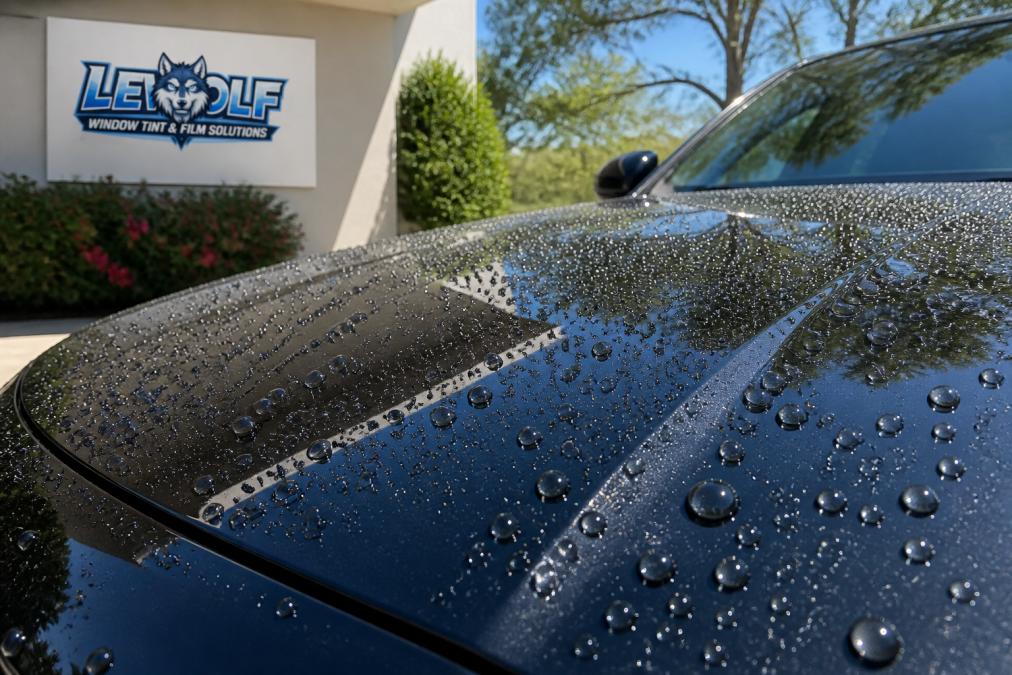
Ceramic wins the beading contest: its higher surface tension pulls water into tight, rounded droplets that roll off at low speeds. Graphene produces a lower contact angle, so water spreads and sheets away instead. Beading looks more dramatic, but sheeting moves water off the panel faster, which is why graphene stays cleaner between washes.
Heat Resistance and Thermal Conductivity
Graphene disperses heat better than SiO2, which shows up on horizontal panels. A dark roof or hood absorbs solar energy all day; higher thermal conductivity spreads that load across the surface instead of concentrating it, slowing localized breakdown of the polymer matrix. For anyone parking outdoors in a hot climate, this is the strongest technical argument for graphene.
Water Spot Resistance
This is graphene's clearest advantage. Water spots form when hard water evaporates and leaves mineral deposits behind. Because graphene sheeting reduces standing water time, there's less opportunity for deposits to etch in. Ceramic's beads sit until they evaporate or roll off, a real maintenance burden in hard water areas.
How Long Does Graphene Coating Last?
Professional-grade graphene coatings typically last one to three years, while consumer sprays fall in the six to twelve month range (pubmed.ncbi.nlm.nih.gov). Ceramic coatings from the same professional tier generally run two to five years. That gap comes down to chemistry, and understanding why helps you predict what you'll actually get.
Why graphene tends to age faster than SiO2
A cured ceramic coating is a rigid, cross-linked silicon-oxygen network, dense and largely inert, which is why it resists chemical attack and holds its hydrophobic behavior for years. Graphene oxide is a two-dimensional carbon sheet dispersed in a carrier resin. The flakes are extremely stable, but the resin bonding them to the clear coat is the weak link. As it oxidizes under UV and thermal cycling, the flakes migrate or lose surface orientation, and slickness and sheeting fade before the coating visibly fails.
That's why graphene coatings often look fine at year two but stop sheeting water the way they did at month two. The coating is still there; the surface energy has changed.
The variables that actually move the number
Durability depends on four variables, in roughly this order of impact:
- Solid content and formulation. A coating with higher solids by volume lays down a thicker, denser film. Two products can both say "graphene" and differ by a factor of three in real-world life.
- Surface preparation. A coating bonds to bare, decontaminated clear coat.
What the warranty actually covers
Layering: can you put graphene over ceramic, or ceramic over graphene?
Removal: how each coating comes off
Neither coating is permanent, but removal differs.
The honest durability take
Ceramic Coating Maintenance Tips
Paint Protection Film vs Ceramic Coating
| Protection Need | Paint Protection Film | Ceramic/Graphene Coating |
|---|---|---|
| Rock chips | Yes | No |
| UV and chemical resistance | Partial | Yes |
| Gloss enhancement | Minimal | Significant |
| Ease of cleaning | Moderate | High |
| Typical lifespan | 5-10 years | 1-5 years |
Which Coating Should You Choose?
Match the coating to your parking situation, not the marketing
| Your situation | Better fit | Why |
|---|---|---|
| Garage-kept, weekend car, gloss-focused | Ceramic | Hardness and gloss depth hold up when the car isn't fighting sun and rain daily |
| Daily driver parked outdoors in a hot climate | Graphene | Better heat dispersion on horizontal panels; sheeting reduces water spot risk |
| Hard water area (sprinklers, irrigation runoff, well water) | Graphene | Faster sheeting means less standing water and fewer mineral deposits |
| High-impact driving (highway commute, track days) | Neither alone | Add paint protection film on impact zones first, then coat over it |
| Budget-conscious first-timer | Hybrid spray | Low cost, low commitment, easy to reapply |
Environmental and safety considerations
What actually determines the outcome
When you're vetting an installer, ask four questions:
Frequently Asked Questions
What are the downsides of graphene coating?
Graphene coatings cost more than standard ceramic options due to the advanced material technology. Professional-grade graphene systems also require meticulous surface preparation, including paint correction and clay bar treatment, before application. Some spray-on graphene products only last 6-12 months, far shorter than multi-year ceramic coatings. Graphene's water spot resistance is better than ceramic, but it is not immune to etching if contaminants sit on the surface for extended periods.
Can you put a graphene coating over a ceramic coating?
You should not layer graphene directly over a cured ceramic coating. Ceramic coatings form a hard, chemically bonded layer on the clear coat, and graphene needs direct contact with the paint surface to bond properly. Applying graphene on top of ceramic can lead to poor adhesion, uneven gloss, and premature failure of both layers. If you want to switch, the existing coating must be removed through polishing before applying the new product.
Does graphene coating prevent water spots better than ceramic?
Yes, graphene coatings generally resist water spot etching better than ceramic coatings. Graphene's lower surface tension and higher thermal conductivity help water sheet off more completely and reduce the concentration of minerals left behind as water evaporates. That said, no coating eliminates water spots entirely. If hard water sits on either surface in direct sun for hours, spotting can still occur. Regular maintenance washes remain the most reliable prevention for both coating types.
How long does a professional ceramic coating last compared to graphene?
Professional ceramic coatings typically last 2-5 years depending on the product tier and maintenance routine. Consumer spray versions of ceramic last around 6-12 months. How long a coating lasts depends heavily on surface preparation, curing time, and whether you follow a proper maintenance wash schedule.
Which is better for car washes, graphene or ceramic coatings?
Both coatings handle automatic car washes better than bare paint, but graphene has a slight edge in slickness, which helps debris slide off with less friction. Ceramic coatings are harder and resist wash-induced micro-scratches well. For either coating, touchless or hand washes with pH-neutral soap extend the life of the layer. Avoid brush-style automatic washes, which can still mar the surface and degrade both ceramic and graphene coatings over time.